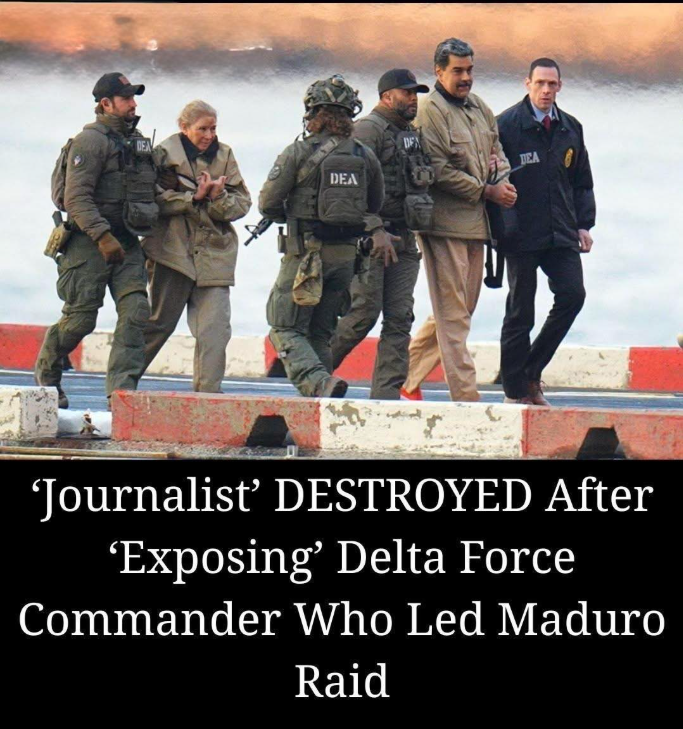
In the hours after U.S. special operations forces carried out the audacious mission that ended Nicolás Maduro’s reign, the story should have been obvious: a narco-dictator finally faced consequences, American power was asserted with precision, and a long-suffering nation saw a glimmer of justice.
Instead, one self-styled left-wing journalist decided the real outrage wasn’t a cartel-linked strongman being removed—it was the people who stopped him.
What followed was one of the most irresponsible episodes of so-called “journalism” in recent memory: a public attempt to identify and expose the commander of one of America’s most secretive and elite military units.
It didn’t just fail.
It detonated—politically, professionally, and ethically.
When Clout Chasing Replaces Judgment
In the modern attention economy, outrage travels faster than facts, and some activists with press credentials have learned that provocation is more valuable than restraint. That dynamic was on full display after the operation that apprehended Maduro and his wife.
Rather than examine the legality of the operation, its geopolitical implications, or the evidence underpinning the charges, the journalist in question made a different calculation: name the warrior, not the war.
Posting on social media, he shared what he claimed was an official photograph and identifying information of a U.S. service member he alleged was the commander of the mission—framing the operation as an “invasion,” dismissing the charges against Maduro, and accusing American forces of atrocities without evidence.
It was reckless.
It was dangerous.
And it was entirely predictable.
Why Elite Commanders Are Not Public Figures
There is a reason commanders of elite special operations units are not household names. It isn’t secrecy for secrecy’s sake. It is operational security.
These individuals oversee missions against terrorist networks, drug cartels, hostile regimes, and transnational criminal organizations. Exposing their identities places not only them at risk, but also their families, their units, and future operations.
This is not controversial inside the national security community. It is foundational.
Publishing identifying information about such personnel is not “holding power accountable.” It is broadcasting a target.
The Backlash Was Immediate—and Deserved
The response online was swift and brutal.
Veterans, military analysts, journalists across the political spectrum, and ordinary Americans piled on—not to defend secrecy for secrecy’s sake, but to condemn an act that crossed a bright red line.
Critics pointed out that even journalists deeply skeptical of U.S. foreign policy have long respected the boundary between scrutinizing decisions and endangering service members. That boundary exists precisely because it protects lives without shielding policymakers from accountability.
The post was soon deleted.
The damage, however, was already done.
Screenshots circulated. Trust evaporated. And the author’s credibility—already thin—collapsed under the weight of his own recklessness.
A Familiar Pattern on the Far Left
This wasn’t an isolated lapse. It fits a broader pattern among a certain strain of left-wing activism that treats America’s institutions as inherently illegitimate while extending endless benefit of the doubt to anti-U.S. actors abroad.
Under this worldview:
Dictators are “complex leaders”
Criminal regimes are “misunderstood”
U.S. military personnel are presumed guilty
Accountability is framed as imperialism
It’s a framework that doesn’t just critique power—it reflexively sides against it, no matter the facts.
In this case, that reflex led directly to an attempt to endanger Americans.
The Absurdity of the Accusation
Perhaps the most revealing aspect of the episode was the claim embedded in the original post: that Maduro was the “rightful president” and that the operation constituted a kidnapping.
This narrative collapses under even minimal scrutiny.
Maduro’s government has been linked by U.S. and international authorities to:
Large-scale drug trafficking
Collaboration with designated terrorist organizations
Electoral fraud
Systematic repression
Human rights abuses
The charges against him were not invented overnight. They are the product of years of investigation, evidence gathering, and legal review.
Dismissing all of that with a tweet while attacking the people who carried out lawful orders isn’t journalism—it’s ideological cosplay.
Why This Hit Backfired So Badly
The reason this attempt failed so spectacularly is simple: most Americans instinctively understand the difference between criticizing policy and putting soldiers in danger.
You can oppose military action.
You can debate legality.
You can question strategy.
What you cannot do—without universal condemnation—is deliberately expose individuals whose anonymity is essential to national security.
The backlash wasn’t partisan. It wasn’t coordinated. It was organic.
And it sent a clear message: this isn’t activism—it’s sabotage.
A Lesson the Media Keeps Learning the Hard Way
The collapse of trust in media didn’t happen because journalists asked tough questions. It happened because too many abandoned basic ethics in pursuit of narrative validation.
This episode crystallized that problem in real time.
Instead of informing the public, the journalist centered himself.
Instead of protecting lives, he chased engagement.
Instead of accountability, he delivered accusation without evidence.
The result was predictable: deletion, retreat, and a reputation in tatters.
Meanwhile, the Mission Speaks for Itself
While activists melted down online, the reality on the ground was far less dramatic and far more consequential.
The operation that apprehended Maduro was executed with precision, minimal collateral damage, and months of planning. It demonstrated coordination across agencies, disciplined command, and strategic clarity.
Those involved did not seek attention.
They did not give interviews.
They did not post selfies.
They did their jobs—and then disappeared back into the shadows where such professionals belong.
The Real Divide
This episode highlighted a stark divide in American discourse:
On one side are people who believe institutions can be criticized while still respecting the men and women who serve within them.
On the other are those who view America itself as the villain—where undermining national security is framed as moral courage.
The public response suggests which side most Americans are on.
Final Thought
Attempting to expose an elite military commander was not brave.
It was not principled.
And it was not journalism.
It was a stunt—one that endangered lives and achieved nothing beyond destroying the credibility of the person who tried it.
In the end, the lesson is simple:
If your “investigation” requires putting Americans at risk to score ideological points, you’re not exposing wrongdoing—you are the wrongdoing.