If there is one unifying principle holding today’s Democratic Party together, it is no longer policy, philosophy, or even ideology. It is opposition—specifically, opposition to Donald Trump. Everything else is secondary, optional, or entirely absent.
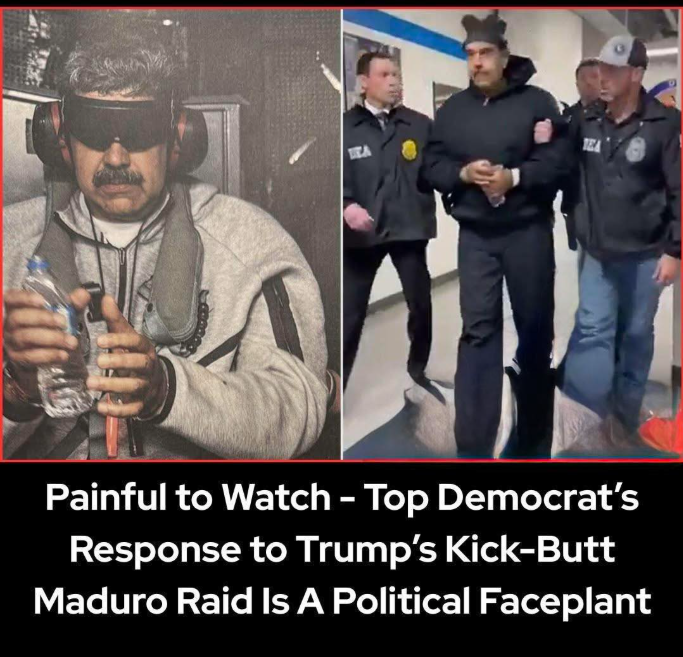
That reality was on full display this week in the aftermath of President Trump’s stunning operation to apprehend Venezuelan strongman Nicolás Maduro. The mission was fast, precise, and—by every measurable standard—successful. Maduro was captured alive. No American troops were killed. The operation avoided civilian casualties and concluded without the kind of prolonged chaos that typically follows regime confrontations.
And yet, instead of grappling with those facts, prominent Democrats responded with visible discomfort, deflection, and in some cases outright confusion. No response better illustrated this than that of Tim Kaine.
A Question Democrats Were Unprepared to Answer
During a televised interview, Kaine was asked a question that should have been straightforward for any serious lawmaker:
If Maduro had been under indictment for years, why did previous administrations fail to bring him to justice?
It was not a trick question. It was not partisan framing. It was a basic inquiry into accountability and results.
Kaine did not answer it.
Instead, he pivoted—first to sanctions, then to allies, then to abstract process concerns. At no point did he address the substance of the question: why decisive action never occurred when Democrats held power, and why it suddenly became unacceptable the moment Trump succeeded.
The evasion was revealing, not because Kaine is uniquely unprepared, but because his response mirrors a pattern that now defines much of his party.
Process Over Outcomes, Even When Outcomes Are Good
For years, Democrats have argued that foreign policy should prioritize multilateralism, caution, and international consensus. Those principles are not inherently flawed. But they become empty slogans when they produce no tangible results.
In Venezuela’s case, the outcome of years of sanctions, statements, and diplomatic pressure was simple: Nicolás Maduro remained in power, Venezuelans continued to suffer, and criminal networks tied to his regime expanded their reach.
Trump’s approach broke from that pattern. It emphasized execution over signaling and results over rhetoric. And when the operation worked, it left critics with an uncomfortable dilemma: how do you oppose something that succeeded without endorsing the very inaction you previously defended?
Kaine’s answer was to avoid the dilemma entirely.
Opposition Without an Alternative
What made Kaine’s response especially emblematic was not merely his criticism of Trump—it was the absence of any alternative proposal.
He did not argue that the mission was illegal.
He did not claim it endangered American troops.
He did not suggest it violated international law in a specific way.
He simply opposed it because Trump did it.
That reflexive resistance has become a defining trait of the modern Democratic Party. Policy positions are increasingly reactive rather than constructive. Successes are treated as liabilities if they originate from the wrong political figure.
In this framework, victory itself becomes suspect.
The Discomfort With American Power
Underlying much of the reaction is a deeper ideological unease: a reluctance to accept that American power, when used decisively, can produce positive outcomes.
Many Democrats are comfortable critiquing U.S. intervention when it fails. They are far less comfortable confronting moments when it works—especially if it contradicts years of warnings about recklessness, instability, or moral hazard.
The Maduro operation forced that confrontation. It demonstrated that force does not always lead to quagmires, that precision can replace prolonged conflict, and that decisive leadership can succeed where bureaucratic caution stalled.
For politicians invested in the opposite narrative, that is deeply inconvenient.
Why Voters Notice These Moments
Most Americans do not follow foreign policy in granular detail. But they understand basic contrasts.
They understand when a leader acts and gets results.
They understand when critics cannot articulate a better plan.
And they notice when objections sound more like resentment than reason.
Kaine’s response did not project seriousness or leadership. It projected discomfort—discomfort with a success that undermined years of Democratic talking points about Trump’s supposed incompetence on the world stage.
That matters politically, especially heading into an election year.
A Party Defined by What It Isn’t
The deeper issue revealed by this exchange is not about Venezuela at all. It is about identity.
What does the Democratic Party stand for in 2026?
Ask that question and the answers are increasingly fragmented. On foreign policy, the party oscillates between restraint and moral posturing, often without reconciling the two. On national security, it struggles to articulate when force is justified—especially if its use contradicts internal narratives about American decline or imperialism.
What remains consistent is opposition to Trump. But opposition alone is not a governing philosophy.
The Cost of Permanent Negation
There is a cost to defining yourself primarily by what you oppose. It leaves you unprepared for moments when reality does not cooperate with your assumptions.
When Trump fails, Democrats know exactly what to say.
When Trump succeeds, they often do not.
Kaine’s interview was not a scandal. It was something more revealing: a moment of intellectual unpreparedness. A moment when critique collapsed because it lacked substance.
And moments like that accumulate.
Conclusion: A Small Moment, a Bigger Signal
Tim Kaine did not lose an argument because he misspoke. He lost it because he had nothing coherent to say.
That silence—filled with evasions and procedural fog—captures a larger crisis within the Democratic Party. A crisis of purpose. A crisis of confidence. And a crisis of credibility when results contradict ideology.
Trump’s operation against Maduro did more than remove a dictator. It exposed a political fault line.
On one side is a leadership style focused on execution and outcomes.
On the other is a party increasingly defined by reaction, hesitation, and refusal to acknowledge success when it comes from the wrong place.
Voters may not follow every foreign-policy debate—but they understand when one side acts and the other merely complains.
And that understanding, quietly but steadily, reshapes elections.