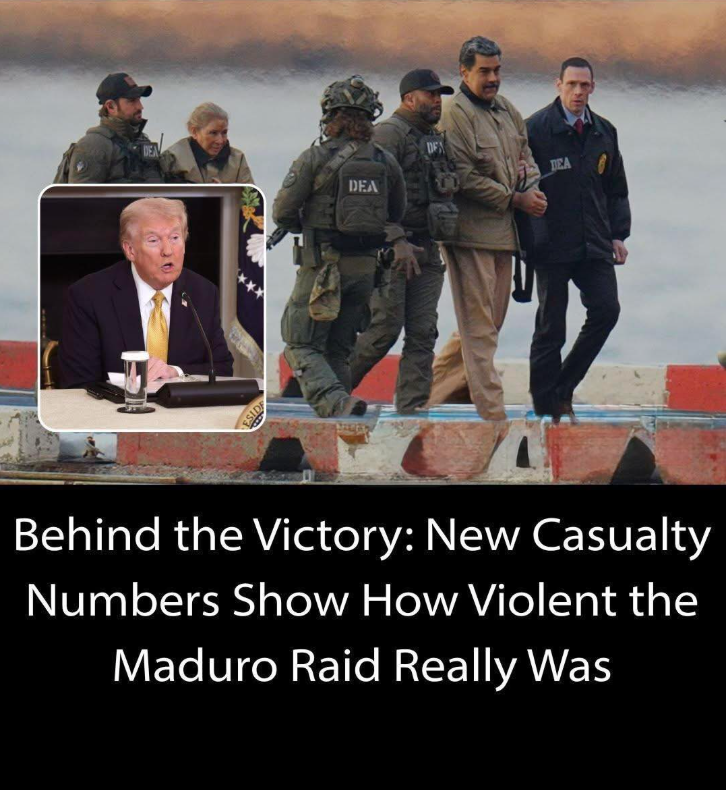
For days after U.S. special operations forces executed their daring overnight mission to capture Venezuelan strongman Nicolás Maduro, critics on the left scoffed at the official narrative. They dismissed the operation as exaggerated, implausible, or outright fabricated. How, they asked, could one of the most heavily guarded dictators in the Western Hemisphere be seized from his own compound without triggering mass bloodshed?
That question now appears to have a very clear—and very sobering—answer.
According to new reporting, the operation was anything but bloodless.
Early Skepticism and Ideological Denial
Almost immediately after the raid became public, left-wing commentators rushed to downplay its scale. Some insisted that Maduro’s removal must have been negotiated quietly, while others implied the United States would never risk a large-scale firefight inside Caracas. A handful of foreign voices sympathetic to authoritarian regimes openly mocked the idea that American forces could penetrate Maduro’s security apparatus at all.
That narrative began to crack when Cuba’s Communist Party unexpectedly declared two official days of mourning.
Havana released photographs and names of 32 Cuban security personnel killed during what it described as a “foreign military action” connected to Venezuela. The announcement sent shockwaves through diplomatic circles. Cuba does not issue public mourning periods lightly—especially not for personnel operating outside its borders.
Suddenly, the suggestion that the Maduro capture occurred without resistance became impossible to sustain.
What the New Reporting Shows
On Tuesday, a detailed report published by the Washington Post—hardly a friendly outlet to the Trump administration—confirmed what critics had denied: the operation was intense, violent, and extraordinarily costly for those defending Maduro.
According to multiple U.S. officials familiar with classified after-action assessments, between 67 and 80 people were killed during the predawn raid. Most estimates now cluster around 75 fatalities.
These deaths reportedly included:
Venezuelan presidential guard units
Cuban military and intelligence personnel embedded within Maduro’s security detail
Armed militia members loyal to the regime
Civilians caught in the chaos surrounding the compound
The firefight occurred primarily within and around Maduro’s heavily fortified residential complex in Caracas, which had been retrofitted over years into something closer to a military installation than a home.
A Fortress, Not a Residence
Intelligence sources describe Maduro’s compound as a layered defensive structure featuring reinforced steel doors, internal safe rooms, and overlapping security zones manned by both Venezuelan and Cuban forces. American planners were well aware that any attempt to seize Maduro alive would encounter significant resistance.
That resistance materialized almost immediately.
As U.S. operators breached the perimeter, regime defenders reportedly engaged in sustained gunfire, triggering a cascading battle across multiple sectors of the compound. Explosives were used to breach secured corridors. Several defensive positions were neutralized in close-quarters combat.
This was not a symbolic arrest.
It was a full-scale special operations assault conducted under extreme time pressure, designed to extract a high-value target before reinforcements could arrive.
Why Cuban Forces Were There
One of the most revealing aspects of the casualty count is the number of Cuban personnel killed. For years, analysts have documented Havana’s deep involvement in propping up the Maduro regime. Cuban advisers reportedly handled intelligence vetting, internal surveillance, and counter-coup operations.
Their presence inside Maduro’s compound underscores just how dependent the Venezuelan dictator had become on foreign protection.
It also explains Cuba’s unusually public reaction.
The deaths represented not just a tactical loss, but a political humiliation for Havana—confirmation that its security guarantees failed when tested by elite U.S. forces.
The Civilian Question
Critics quickly seized on the report’s acknowledgment that civilians may have been killed during the operation. That reality, while tragic, is not unexpected given the regime’s long-standing practice of embedding armed personnel within civilian areas and infrastructure.
U.S. officials emphasize that the mission prioritized minimizing civilian harm and that the majority of fatalities were armed combatants. However, when authoritarian regimes militarize residential zones, civilian exposure becomes inevitable.
It is a grim reminder of who truly bears responsibility for such risks.
Why the Left Is Uncomfortable With the Truth
The emerging details pose a problem for Trump’s political opponents. The operation was:
Legally justified under existing indictments and counter-narcotics authorities
Militarily successful
Executed without American casualties
Followed by the live capture of a sitting dictator
That combination is rare.
Acknowledging the scale of the operation also means admitting that the United States demonstrated overwhelming force, precision, and resolve—qualities critics have long claimed were absent.
Instead of a reckless adventure, the Maduro capture is increasingly being viewed as a textbook example of modern special operations doctrine: speed, surprise, overwhelming superiority, and decisive extraction.
Strategic Implications
The raid sends a message far beyond Venezuela.
Authoritarian leaders who have relied on layered security, foreign mercenaries, and urban fortifications are now being forced to reassess their assumptions. The notion that embedding oneself among civilians guarantees immunity has been badly shaken.
So has the belief that U.S. political divisions automatically translate into strategic paralysis.
The Bottom Line
The idea that Nicolás Maduro was quietly escorted out of Venezuela without resistance was never credible. The new reporting confirms what many suspected: removing a narco-dictator entrenched for decades required force—and significant force at that.
Roughly 75 people died defending a regime built on repression, corruption, and fear. No American service members were lost. Maduro now faces justice in a courtroom rather than issuing decrees from behind barricades.
That outcome may be uncomfortable for critics, but it is difficult to dispute.
The operation worked.
And the cost of keeping Maduro in power turned out to be far higher than many were willing to admit.