
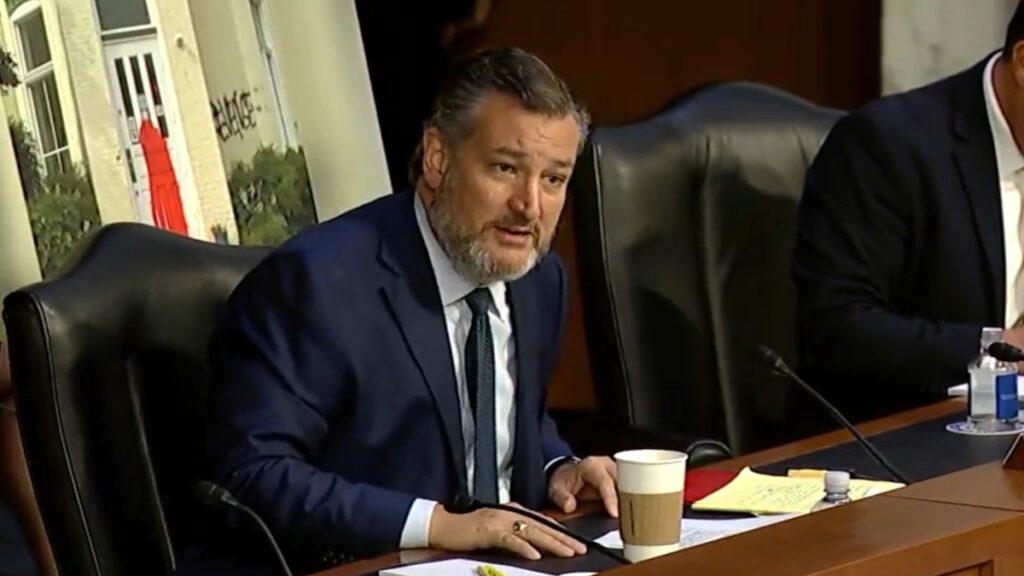
Washington never disappoints when it comes to chaos and controversy. On Wednesday, Sen. Ted Cruz (R-Texas) used a Senate hearing to call for the impeachment of two federal judges, James Boasberg and Deborah Boardman, arguing they have abused their authority from the bench.
Boardman, in particular, has drawn sustained criticism from conservatives. Long accused of suffering from a severe case of Trump Derangement Syndrome, she is also the judge who issued what many view as a shockingly lenient sentence to an individual who attempted to assassinate a sitting Supreme Court justice—a decision that stunned legal observers and outraged the public.
It seems Cruz is through playing nice with these left-wing partisans posing as judges:
Sen. Ted Cruz, R-Texas, on Wednesday called on Congress during a Senate hearing to impeach two federal judges, making his most elaborate case yet for imposing the extraordinary sanction on a pair of closely scrutinized jurists.
Cruz acknowledged that impeaching federal judges is exceedingly rare — 15 have been impeached in history, typically for straightforward crimes like bribery — but the Texas Republican argued it was warranted for judges James Boasberg and Deborah Boardman.
“Rarer still, until now, were the deeper offenses the framers feared most — judges who, without necessarily breaking a criminal statute, violate the public trust, subvert the constitutional order or wield their office in ways that injure society itself,” Cruz said. “That is why, throughout history, Congress recognized that impeachable misconduct need not be criminal.”
Cruz may be reminding Democrats of an inconvenient truth: impeachable misconduct does not have to rise to the level of a crime. After all, if the two impeachment drives against President Trump during his first term taught us anything, it’s that—at least in Democratic circles—impeachable misconduct doesn’t even need to be grounded in fact.
Enjoying our conservative reporting and commentary? Make sure to share our content with your friends!
That said, reality intrudes. However justified the argument may be, the odds of these impeachments actually moving forward are slim at best. The political will on the left simply isn’t there:
Cruz, a Senate Judiciary Committee member with an extensive legal background, said the House needed to initiate impeachment proceedings over controversial gag orders Boasberg signed in 2023 and a sentence Boardman handed down last year in the case of Justice Brett Kavanaugh’s attempted assassin.
Impeachment proceedings must be initiated in the House and typically run through the House Judiciary Committee.
Russell Dye, a spokesman for the GOP-led committee, said “everything is on the table” when asked if Chairman Jim Jordan, R-Ohio, was open to the idea. If the House were to vote in favor of impeachment, it would then advance to the Senate. Two-thirds of senators would need to vote to convict the judges and remove them, a highly improbable scenario because the vote would require some support from Democrats.
The chances of Senate Republicans persuading enough Democrats to support a conviction are effectively nonexistent—about as likely as Sen. Chuck Schumer (D-N.Y.) spontaneously sprouting wings and flying off to Jupiter.
Still, that doesn’t make the effort pointless. Even if it goes nowhere, it sends a clear message: judges who indulge in this kind of reckless, ideological foolishness should not expect it to pass without challenge:
In the case of Boardman, a Biden appointee, the judge sentenced Sophie Roske, who previously went by Nicholas Roske, to eight years in prison after the Department of Justice sought a 30-year sentence. Roske pleaded guilty to attempting to murder Kavanaugh. Boardman said she factored into her sentence that Roske identified as transgender and therefore faced unique adversity.
Now that is outright malfeasance.
Cruz’s call for impeachment is largely symbolic, but symbolism has its place. There is value in raising a public alarm when a judge or politician commits an egregious act. There is value in forcing attention onto misconduct that would otherwise be brushed aside or quietly normalized.
A symbolic impeachment effort—unlikely as it is to succeed—still serves a purpose. It draws lines, clarifies stakes, and puts officials on notice that their actions are being watched and remembered. This is politics, not civics-class fantasy: a messy, often ugly business where messaging matters. That is exactly what this move is, whether it advances procedurally or not.