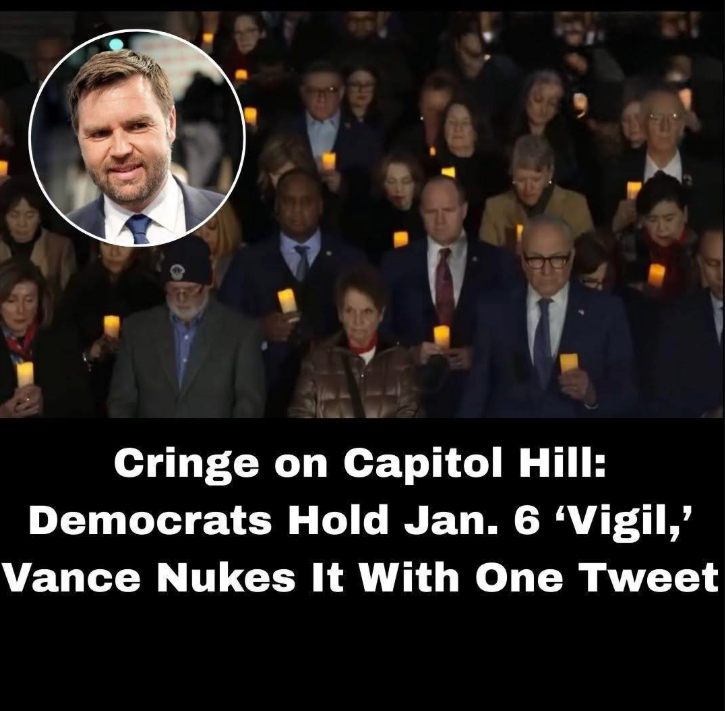
Five years after January 6, Democrats once again gathered to commemorate the event with solemn speeches, dramatic language, and an unmistakable sense of theatrical self-importance. Candlelight imagery, carefully chosen words, and social-media declarations framed the day as an existential near-death experience for American democracy.
And then came one tweet.
Vice President J.D. Vance didn’t issue a long statement. He didn’t hold a press conference. He didn’t lean into symbolism or emotional appeals. Instead, he punctured the entire spectacle with a brief, blunt message that resonated far more widely than the vigil itself—and that contrast told you everything you needed to know about the current political divide.
A Ceremony in Search of Proportion
Democratic leaders used the anniversary as an opportunity to restate a familiar claim: that January 6 was one of the gravest threats to the United States since its founding. Some described it as the darkest day in modern history. Others framed it as proof that democracy itself is fragile and perpetually on the brink.
The problem with that narrative is not that January 6 was insignificant—it wasn’t. It was chaotic, disorderly, and unacceptable. But Democrats continue to inflate it beyond all historical proportion, transforming a riot into a near-apocalyptic event that supposedly eclipses wars, assassinations, domestic terror campaigns, and centuries of actual existential crises.
Americans notice when context disappears.
This was a nation that survived a civil war that killed more Americans than all foreign wars combined. A country that endured global conflicts, nuclear standoffs, widespread domestic terrorism in the 20th century, and months-long riots that destroyed entire neighborhoods in living memory.
Yet year after year, Democrats insist that a single afternoon—ugly, criminal, and embarrassing as it was—stands above all of it.
That insistence increasingly sounds less like sober reflection and more like political branding.
Performative Mourning as Political Strategy
The vigil itself followed a familiar pattern. Carefully framed visuals. Somber tones. Repetition of the same phrases that have been recycled since 2021. Social-media posts designed for maximum emotional reach rather than historical clarity.
For Democratic leadership, January 6 has become less an event to understand and more a tool to wield.
It functions as a moral shortcut—one that allows the party to avoid grappling with its own failures while positioning itself as the sole guardian of democracy. Inflation, border chaos, crime, foreign instability, and institutional distrust fade into the background when everything can be filtered through one endlessly repeated talking point.
But the American public has a limited tolerance for ritualized outrage.
Each year the language escalates. Each year the comparisons grow more absurd. And each year the credibility of the message weakens.
Enter Vance: No Speech, No Sermon
Against that backdrop, Vice President J.D. Vance responded not with a counter-ceremony, but with something far more effective: clarity.
His tweet—brief, direct, and unsparing—cut through the noise by stating what millions of Americans already believe but rarely hear articulated by national leaders. The message wasn’t about minimizing wrongdoing. It was about rejecting the idea that democracy nearly collapsed because of a few hundred lawbreakers who were ultimately dispersed, prosecuted, and absorbed by the legal system.
The underlying point was devastating in its simplicity:
If American democracy can be “almost destroyed” by a disorderly crowd without weapons, without military support, and without institutional backing, then it was never strong to begin with.
That argument resonated precisely because it treated Americans like adults.
Why the Tweet Landed So Hard
Vance’s response succeeded where the vigil failed because it restored perspective.
Most Americans do not see their country as a porcelain vase—shattering at the first sign of unrest. They understand that democratic systems are tested not by chaos alone, but by how institutions respond to it.
On January 6, institutions did respond.
Congress reconvened.
The electoral count was certified.
The system held.
That reality doesn’t excuse criminal behavior—but it does contradict the narrative of near-collapse Democrats continue to promote.
By refusing to indulge the melodrama, Vance reminded voters of something deeply unfashionable in modern politics: resilience.
The Fatigue Factor
There is also a growing exhaustion surrounding January 6 rhetoric.
For five years, Democrats have returned to the same well, using the event as justification for everything from speech regulation to expanded surveillance to political prosecutions that many Americans perceive as unevenly applied.
At the same time, far more recent crises—rising costs of living, housing shortages, border failures, violent crime—remain unresolved.
To voters juggling rent, groceries, and safety concerns, another candlelight vigil does not feel like leadership. It feels like avoidance.
Vance’s message landed because it acknowledged that fatigue instead of scolding it.
Democracy Is Not a Stage Prop
One of the deeper issues exposed by the vigil is how casually the word “democracy” is now used.
Democracy has become a prop—a word deployed to sanctify one side and demonize the other. It is invoked selectively, loudly, and often without regard for consistency.
When protests turn violent under progressive banners, they are contextualized.
When institutions defy voters, it’s framed as necessary.
When dissent challenges Democratic orthodoxy, it’s labeled dangerous.
This selective outrage has hollowed out the concept Democrats claim to protect.
Vance’s response implicitly challenged that hypocrisy—not by defending January 6, but by rejecting its weaponization.
A Contrast in Political Philosophy
The episode revealed more than disagreement; it exposed two fundamentally different views of the American system.
One side sees democracy as fragile, perpetually endangered, and in constant need of elite protection. The other sees it as durable—capable of surviving disorder precisely because it is grounded in institutions, laws, and civic resilience rather than emotional consensus.
The vigil embodied the first view.
The tweet embodied the second.
And judging by public reaction, the latter is gaining ground.
Conclusion: The Power of Saying Less
In modern politics, volume often substitutes for substance. Outrage replaces argument. Symbolism replaces solutions.
That is why Vance’s response mattered.
He didn’t deny history.
He didn’t excuse wrongdoing.
He didn’t inflame emotions.
He simply refused to pretend that the United States—a nation that has endured far worse—was nearly undone by a single chaotic day.
Sometimes, the most devastating rebuttal is not a speech, a vigil, or a hashtag.
Sometimes, it’s one sentence that restores perspective—and exposes the performance for what it is.