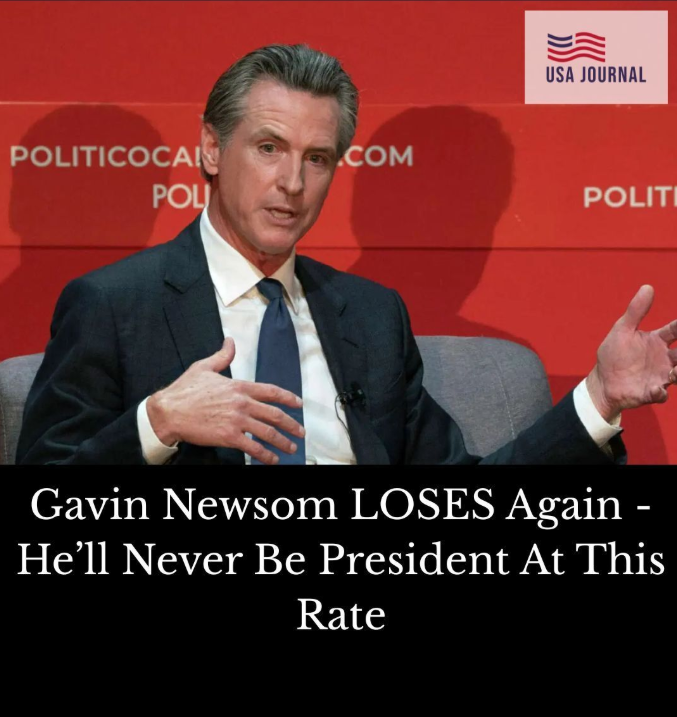
No one said running for president was easy, although Donald Trump managed to make it look simple. But that same difficulty is now staring Gavin Newsom in the face and there isn’t any easy answer for the dilemma he’s facing.
Politico published a story Friday detailing the growing clash between California Gov. Gavin Newsom and the progressive wing of his own party.
The subtext is obvious. With his eye on a 2028 presidential run, Newsom is attempting a political balancing act that borders on the impossible. On one hand, he wants to present himself as a “serious” national candidate by finally confronting California’s runaway spending and chronic budget problems. On the other, he remains tethered to a progressive base that helped create the fiscal mess in the first place and has little appetite for restraint:
Newsom, people around him say, is determined to leave California with a balanced budget. He knows many voters outside the state would be wary of a San Francisco Democrat, and leaving California’s budget in fragile shape could open him to attacks from 2028 rivals or from the next governor, who could pin a deficit on the mess Newsom left behind.
“There’s going to be two years between the end of (Newsom’s) term as governor and potentially running for president,” said Jeff Freitas, head of the California Federation of Teachers. “California has to be successful in those two years.”…
“The governor wants to leave the next governor a stable and balanced budget that protects essential services for the most vulnerable, and continues to spur innovation and economic growth in this state,” [spokesperson Bob] Salladay said in a statement.
But balancing the budget — and selling himself as a competent administrator to a national audience — will be far harder than Newsom’s rhetoric suggests. Just weeks ago, the California Legislative Analyst’s Office projected a looming $18 billion deficit, warning that even larger shortfalls are likely in the years ahead:
The state is facing huge budget deficits despite an ebullient stock market and capital-gains rush.
That was the warning last week from the state Legislative Analyst’s Office (LAO). The nonpartisan policy adviser projects an $18 billion budget gap in the coming fiscal year and $35 billion shortfalls after that. This may be optimistic since it assumes no recession or severe market correction in the next several years. What are the odds of that?
The fundamental problem, LAO says, is “spending growth continuing to outstrip revenue growth.”
The real problem, of course, is runaway spending — a reality few Democrats are willing to acknowledge in a one-party blue state where fiscal accountability has become optional. Newsom could likely slash the deficit dramatically by admitting the obvious: extending taxpayer-funded Medicaid benefits to illegal immigrants is unaffordable. But that would require political honesty, and Newsom has shown little interest in that path.
Instead, he is left with the only option Democrats ever seem to embrace — squeezing more money out of someone else. With another $18 billion needed each year, Newsom must decide by June 2026 where that revenue will come from.
Progressives already have their answer. They are pushing a so-called “one-time wealth tax,” targeting fewer than 200 California residents. It’s the familiar playbook: punish success, chase capital out of the state, and pretend the bill for years of overspending can be paid by a tiny group of politically convenient ‘villains’:
Now, the state is seeking a billionaire tax and making it retroactive. Thus, even if you were waiting to decide to leave, it is too late. You are being taxed for the prior year…
The “2026 Billionaires Tax Act” would impose a one-time 5% tax on individual wealth exceeding $1 billion. While technically using 2026 wealth figures, it would apply to billionaires who resided in California in 2025. So you cannot hope to flee… at least with your wealth intact. It is a penalty for those who stayed too long hoping that rational minds would prevail in California.
A so-called wealth tax isn’t a modest skim off annual income — it’s a direct grab at everything you own. A 5% wealth tax means the state claims 5% of your total assets, not your yearly earnings.
If you’re a major shareholder in a company you built, own valuable artwork, or hold real estate, the government wouldn’t just ask politely for a check. You’d be subjected to an intrusive audit to catalog every asset, after which you’d be forced to liquidate roughly 5% of your holdings to satisfy the tax bill. In practice, that means selling pieces of your business, your property, or other long-term investments — whether it’s a smart time to sell or not — simply to feed the state’s appetite for more spending.
Supporters of the proposal claim a so-called “one-time” wealth tax would raise $100 billion upfront, allowing the state to spread the money out at roughly $25 billion a year over four years — enough to paper over the budget deficit and even leave room for new spending. And after that? We’re told California would magically be on its own again. Does anyone seriously believe that? More importantly, would the roughly 180 billionaires targeted by the tax believe it — or would they pack up and leave to avoid being hit again?
To his credit, Newsom has rejected the idea. He may be a leftist, but he’s not naïve. Newsom understands that once you prove you’re willing to confiscate wealth on that scale, many of the state’s richest job creators will leave for good. And when they go, so does a massive share of California’s tax base. You can’t keep taxing billionaires if they relocate to Texas or Florida — and California’s long-term finances would be even worse off once they do:
Dan Newman, a political adviser opposing the campaign to tax billionaires, said Newsom is against a plan to slap a one-time, 5% tax on roughly 200 Californians worth more than $1 billion to “replace lost federal dollars and protect essential services,” as described by the campaign’s website…
The governor’s opposition is a blow to progressives and labor interests backing the tax…
So that’s where we’re at for now; Newsom wants to balance the state’s budget but wants to do so without punishing the state’s wealthiest job creators. However, the left-wing loonies are, ahem, urging him to change his mind:
If he holds the line on taxes, he risks alienating unions and progressive allies who form the backbone of the Democratic electorate. If he doesn’t, he risks reinforcing the Republican caricature of him as a California tax-and-spend liberal, and driving away moderate voters and the titans of California industry who have supported Newsom since he first entered politics…
“There is this idea he’s trying to appeal as not a tax-and-spend guy,” said Alex Lee, a state lawmaker who chairs a group of progressive Democrats pushing for more revenue. “Americans of all political stripes do not love billionaires right now, and if you’re seen as a defender of billionaires that’s going to hurt you down the line.”…
“It’s clear this administration is trying to attack the most vulnerable among us,” said SEIU California Executive Director Tia Orr. “I trust and am confident that this governor is going to do everything in his power to protect those folks from receiving the hits that this administration is aiming directly at them.”
That’s the clean, carefully packaged version progressives are willing to float to friendly news outlets. Behind closed doors, it almost certainly sounds very different. It always does when unions and activist groups are involved. Their leverage isn’t persuasion — it’s threats. Do this or else.
Tax the billionaires, or we’ll brand you a stooge for the wealthy. A defender of billionaires. A friend of Elon Musk. That’s almost certainly the pressure campaign Gavin Newsom is facing out of public view.
How Newsom navigates this mess will be telling. He can continue to reject the wealth tax, but if he’s serious about balancing the budget, he still has to come up with an enormous amount of money — and soon. The obvious, responsible move would be to cut spending and prove he’s capable of making hard decisions. But for progressives, that would amount to an unforgivable double betrayal: no wealth tax and spending restraint.
Newsom has roughly six months to sort it out. Whether he chooses fiscal reality or progressive appeasement will say a lot about whether his national ambitions outweigh California’s financial future.