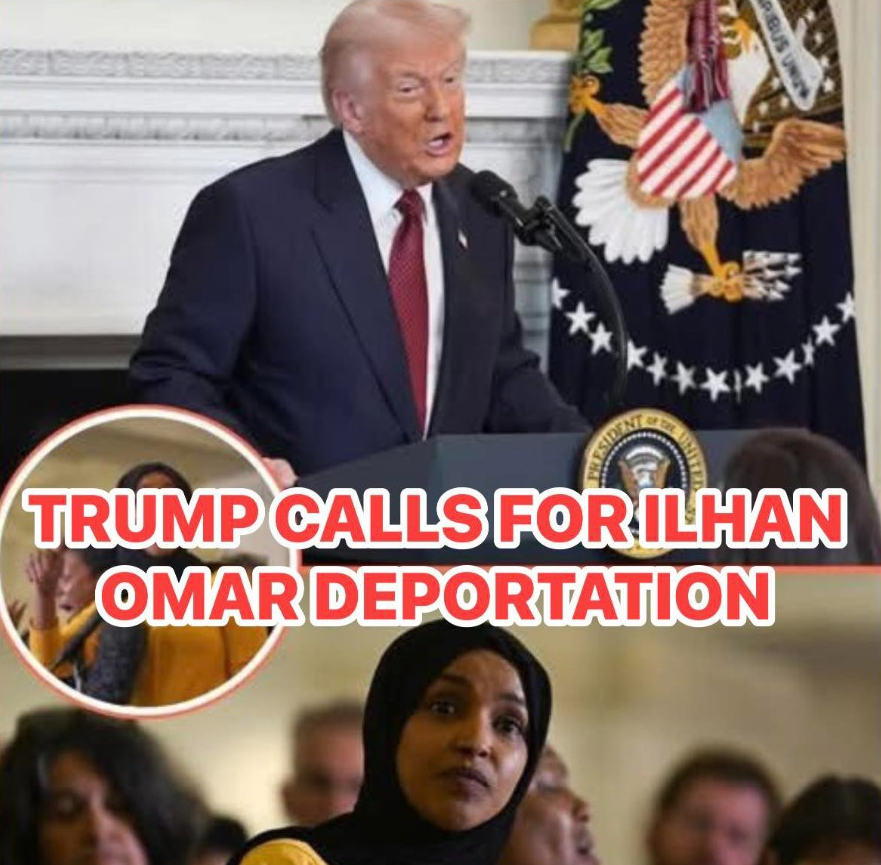
In a moment that instantly ricocheted across cable news, social media, and the halls of Congress, former President Donald J. Trump ignited a political firestorm during a live rally appearance when he unleashed a blistering verbal attack against Representative Ilhan Omar, declaring, “If you hate America so much — get the HELL out of our country.”
The remark, delivered to a roaring crowd and broadcast live to millions, marked one of the most incendiary confrontations of the 2025 political cycle so far. Supporters erupted in applause. Critics called it dangerous. Allies praised it as “truth-telling.” Opponents condemned it as divisive and unconstitutional rhetoric.
Within minutes, the clip went viral.
But what followed was far more than just another Trump headline — it became a defining flashpoint in a broader war over nationalism, immigration, free speech, and the boundaries of political discourse in a deeply fractured America.
A RALLY MOMENT THAT SHOOK THE POLITICAL LANDSCAPE
The rally, held in a packed arena in the Midwest, had already carried the familiar rhythms of a Trump event: music, chants of “USA,” fiery denunciations of the Biden-era legacy, and promises of “restoration” and “law and order.”
But the atmosphere shifted dramatically when Trump pivoted to Congress.
“Look at what’s happening in Washington,” Trump told the crowd. “We have people in our government who openly trash this country, who side with our enemies, who call America racist, evil, broken — and then expect to be treated like patriots.”
Then came the line that set off the explosion.
“And Ilhan Omar — she’s a con,” Trump said. “A total con. If you hate America so much, if everything about this country disgusts you — get the HELL out of our country.”
The crowd erupted.
Chants followed. Phones went up. The clip spread in real time.
WHO IS ILHAN OMAR — AND WHY SHE REMAINS A LIGHTNING ROD
Representative Ilhan Omar, a Democrat from Minnesota, has long been one of the most polarizing figures in American politics.
A member of the so-called “Squad,” Omar has frequently criticized U.S. foreign policy, immigration enforcement, law enforcement practices, and what she calls “systemic injustice” embedded in American institutions. Her supporters view her as a courageous truth-teller. Her critics argue she crosses the line from criticism into hostility toward the nation itself.
Trump has targeted Omar before — but never quite this directly, or this publicly, during a live broadcast event.
This time, the phrasing — “get the HELL out of our country” — struck a nerve across the political spectrum.
IMMEDIATE FALLOUT: PRAISE, OUTRAGE, AND POLITICAL WAR
Trump Allies Applaud
Within hours, prominent conservative figures rushed to Trump’s defense.
“This is what millions of Americans feel but are afraid to say,” said one GOP strategist. “If you openly despise the country you serve, why are you in Congress?”
Several Republican lawmakers echoed the sentiment, arguing that Trump was criticizing Omar’s rhetoric, not her identity.
“He didn’t say anything about race or religion,” one House Republican said. “He challenged her loyalty and ideology — that’s fair game.”
Right-wing media amplified the moment, branding it a “patriotic stand” against what they call “anti-American radicalism.”
Democrats Cry Foul
Democrats reacted with fury.
House leadership released statements condemning the remarks as “dangerous,” “un-American,” and “a threat to democratic norms.”
“This kind of language incites hate and violence,” one Democratic senator said. “Telling a sitting member of Congress to ‘get out of the country’ is authoritarian rhetoric, plain and simple.”
Progressive activists accused Trump of dog-whistle politics, arguing that similar rhetoric has historically been used to marginalize minorities and political dissidents.
Ilhan Omar herself responded hours later with a brief but pointed message.
“I am an American,” she wrote. “I was elected by Americans. I will continue to fight for justice in this country — no matter how loud the hate gets.”
THE LEGAL AND CONSTITUTIONAL QUESTION
Beyond the political uproar, constitutional scholars quickly entered the debate.
While Trump’s statement carries no legal force, experts warned that rhetoric suggesting certain Americans should leave the country for their beliefs is deeply problematic.
“The First Amendment protects dissent,” said one constitutional law professor. “Disagreement with U.S. policy does not make someone less American.”
Others countered that Trump’s remarks fall squarely within protected political speech.
“He didn’t call for deportation,” another analyst noted. “He expressed a harsh opinion — which, under the Constitution, he is free to do.”
This legal gray zone has become a hallmark of Trump-era discourse: speech that is provocative, divisive, but legally protected.
A STRATEGIC MOVE — OR A POLITICAL GAMBLE?
Political analysts are divided over whether the moment represents a calculated strategy or an impulsive eruption.
The Strategy Argument
Some argue Trump deliberately chose Omar as a symbol.
“She embodies everything Trump’s base believes is wrong with modern Washington,” said a veteran campaign advisor. “Criticism of America, identity politics, globalism — Omar is a perfect foil.”
By reigniting conflict with a high-profile progressive lawmaker, Trump re-centers the cultural battle lines that helped propel him to power in the first place.
The Risk Argument
Others warn the moment could backfire.
“Independent voters are exhausted by this kind of rhetoric,” one swing-state analyst said. “They want solutions, not personal attacks.”
There is also concern that the comment could energize Democratic turnout, particularly among younger voters and minority communities.
MEDIA ERUPTION: WALL-TO-WALL COVERAGE
Cable news immediately split along familiar lines.
Conservative outlets framed the remark as a “patriotic challenge to radicalism.”
Liberal networks labeled it a “dangerous escalation.”
Mainstream outlets focused on the broader implications for political norms.
Panel debates raged late into the night.
Was Trump defending national identity — or undermining democratic pluralism?
Was Omar’s record fair game — or was the rhetoric crossing into exclusionary nationalism?
The clip ran on a loop.
SOCIAL MEDIA: A NATION DIVIDED IN REAL TIME
On social platforms, the reaction was instantaneous and ferocious.
Trending hashtags included:
#GetOut
#IStandWithOmar
#AmericaFirst
#TrumpLive
Supporters posted memes praising Trump’s bluntness. Critics shared historical comparisons to past periods of political repression.
The divide was raw — and revealing.
HISTORICAL CONTEXT: A FAMILIAR AMERICAN TENSION
Historians note that this is far from the first time Americans have clashed over who “belongs.”
From the Alien and Sedition Acts, to McCarthyism, to Vietnam-era protests, the question of whether dissent equals disloyalty has haunted American politics for centuries.
“What makes this moment unique,” one historian said, “is the speed and scale at which such rhetoric spreads — and the intensity with which it polarizes.”
WHAT THIS MEANS FOR THE 2026 AND 2028 LANDSCAPE
While Trump has not formally announced his next political move, moments like this reinforce his continued dominance of the Republican narrative.
The GOP base remains energized by his confrontational style. Meanwhile, Democrats see the incident as proof that Trump remains, in their words, “unfit and divisive.”
This single rally moment may echo for months.
Campaign ads. Fundraising emails. Debate soundbites.
It is already being weaponized by both sides.
ILHAN OMAR’S FUTURE — AND TRUMP’S
For Omar, the attack may paradoxically strengthen her standing among progressives, who view her as a target precisely because she challenges entrenched power.
For Trump, the moment underscores both his strength and his vulnerability: unmatched ability to command attention — and unmatched ability to inflame opposition.
In modern American politics, attention is power.
And Trump still knows exactly how to seize it.
CONCLUSION: A MOMENT THAT DEFINES AN ERA
Whether hailed as patriotic defiance or condemned as dangerous rhetoric, Trump’s live rally declaration has become more than a headline.
It is a mirror reflecting a nation wrestling with its identity — who belongs, what loyalty means, and how far political speech can go before it tears the fabric it claims to defend.
One thing is certain:
America heard him loud and clear.
And the fallout is far from over.