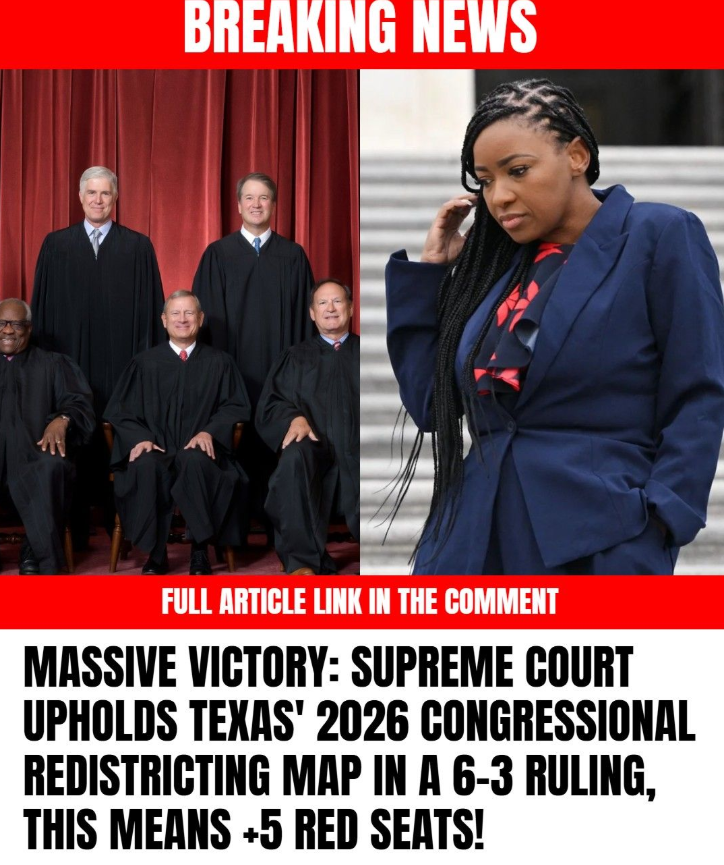
In a Tense 6-3 Stay, Justices Pause Racial Gerrymandering Block, Allowing Mid-Decade Redraw to Shape 2026 Battles in America’s Fastest-Growing State
In the sprawling suburbs of suburban Houston, where the morning sun glints off the roofs of ranch-style homes and the distant thrum of I-45 carries commuters to jobs in the energy patch, Sofia Ramirez pulled her minivan into the driveway of her two-story colonial on December 5, 2025, her hands still gripping the wheel a little tighter than usual. Ramirez, 39, a high school counselor whose family roots stretch back to the border town of Laredo, had just dropped her kids at school when her phone buzzed with the news alert: The U.S. Supreme Court had paused a lower court’s block on Texas’ new congressional map, clearing the way for the redrawn lines to guide the 2026 midterms. For Ramirez, whose neighborhood in Harris County flipped blue in 2018 for the first time in generations, the ruling felt like a subtle shift in the ground beneath her—her district, once a patchwork of Latino voters and urban progressives, now stretched into whiter, wealthier enclaves that diluted her voice. “We fought for seats that see us, that fight for our schools and healthcare,” she said later, stirring sugar into her cafecito at a local panadería, the aroma of fresh conchas mingling with her quiet frustration. “Now, it’s like they redrew the rules while we were sleeping—making it harder for folks like me to matter.” Across Texas’ vast expanse, from the Panhandle prairies to the Rio Grande Valley, the court’s 6-3 stay wasn’t just a legal footnote; it was a reshaping of power, a map that promised Republican gains but stirred the hearts of communities long attuned to the feel of lines drawn against them.
The decision, issued as an unsigned per curiam order on December 4, granted Texas’ emergency application to stay a November 18 ruling from a three-judge panel in El Paso, which had found the mid-decade redistricting “likely unconstitutional” under the Voting Rights Act for racial gerrymandering. The panel, led by Judge Xavier Rodriguez—a George W. Bush appointee—in a 2-1 opinion, cited “substantial evidence” that Governor Greg Abbott and Republican lawmakers had directed mapmakers to use race as a predominant factor, cracking Latino-majority districts in Houston and Dallas while packing Black voters into fewer safe blue seats. “The 2025 Map is the most blatant exercise of judicial activism,” dissenting Judge Jerry Smith, a Reagan appointee, fired back, but the majority ordered a return to the 2021 boundaries, disrupting filings just weeks before the December 8 deadline. Texas appealed swiftly, with Attorney General Ken Paxton arguing irreparable harm to the electoral timeline and insisting the redraw was “pure politics,” not prejudice—a defense rooted in the Supreme Court’s 2019 Gill v. Whitford ruling allowing partisan gerrymandering absent racial animus. The high court’s conservative majority—Chief Justice John Roberts, joined by Justices Clarence Thomas, Samuel Alito, Neil Gorsuch, Brett Kavanaugh, and Amy Coney Barrett—agreed to pause the block, citing the “rapidly approaching” primaries on March 3 and the chaos of mid-filing shifts. “Disruption to the election process outweighs the equities at this stage,” the order noted, setting the stage for full merits review in 2026.
Texas’ mid-decade maneuver, a rarity outside decennial censuses, ignited in the sweltering summer of 2025, when Abbott called a special session on July 15 amid a Department of Justice letter flagging “constitutional concerns” in four “coalition districts”—majority-minority seats blending Black and Latino voters that flipped blue in 2022. What followed was a frenetic 10-day sprint in Austin’s air-conditioned capitol, where GOP majorities—86-64 in the House, 19-12 in the Senate—crafted a “Big, Beautiful Map” signed August 29, projected to shift the state’s 38-seat delegation from 25-13 Republican-Democrat to 30-8, netting five GOP gains nationally. Lawmakers like Rep. Matt Schaefer of Tyler defended it as reflecting “Texans’ conservative preferences,” but plaintiffs—from the ACLU and LULAC to Black Voters Matter—alleged racial sorting: Splitting Harris County’s Latino growth into three red-leaning seats, diluting Dallas’ Black influence by 15 percentage points. “This isn’t evolution; it’s engineering to silence our growing voices,” said Nina Perales, MALDEF’s vice president, in a November 18 presser outside the El Paso courthouse, her words carrying the weight of decades litigating VRA cases. The panel’s injunction, effective immediately, upended candidate signatures and primary planning, a disruption the Supreme Court deemed too acute to ignore under the Purcell principle—the 2006 doctrine barring last-minute rule changes to avoid confusion.
For Ramirez, whose 18th District—once a Latino opportunity seat held by Democrat Sylvia Garcia—now merges with suburban conservatives in Montgomery County, the ruling stirs a mix of resignation and resolve. A first-generation American whose parents crossed the border as teens in the 1970s, she canvassed door-to-door in 2022, knocking on Spanish-speaking homes to boost turnout that helped Garcia win by 20 points. “My abuela couldn’t vote back then—now my ballot might not count because they stretched the lines to water us down?” Ramirez asked, her hands gesturing over her cooling coffee as rain pattered against the panadería’s window. Her neighborhood, a vibrant blend of taquerias and quinceañera dress shops where block parties spill onto lawns, saw 75% turnout in 2020, flipping precincts blue amid suburban shifts. But the map’s “crack” scatters 40,000 Latino voters across two districts, per Dave’s Redistricting analysis, echoing Section 2 of the VRA’s protections against minority dilution—a standard the El Paso panel found breached, but which the high court deferred for fuller review.
The Supreme Court’s conservative bloc, steady since Barrett’s 2020 confirmation, has navigated redistricting with a federalist bent that prioritizes state autonomy over federal oversight. Roberts’ majority, in a concise order, invoked Purcell’s caution: With filings open and campaigns underway, reverting to 2021 lines risked “voter confusion and unequal treatment.” Alito, in a concurrence joined by Thomas, underscored the partisan core: “Texas’ motivation was political, not racial—a distinction the VRA respects.” The dissent—Justices Sonia Sotomayor, Elena Kagan, and Ketanji Brown Jackson—dissented sharply, Sotomayor writing that the stay “rewards the very racial gerrymandering the law forbids,” citing Abbott’s “explicit racial directives” in legislative emails uncovered during discovery. Jackson added a poignant equity note: “Maps that silence communities of color aren’t neutral—they nullify the promise of equal voice.” The 6-3 split aligns with recent precedents: Allen v. Milligan (2023) upholding VRA challenges to Alabama’s Black voter dilution, but Rucho v. Common Cause (2019) declining partisan claims for lack of judicial standards. For Texas, the stay secures the map through 2026 primaries, buying time for appeals that could reach merits arguments by fall.
Reactions swept across Texas like a norther, stirring the pot from Austin boardrooms to border-town barbershops. In the capitol’s rotunda, where murals of Tejanos and Comanches gaze down on polished marble, GOP leaders like House Speaker Dade Phelan raised fists in a December 5 caucus toast. “This affirms our right to reflect Texas’ true colors—red, proud, and unyielding,” Phelan said, his East Texas twang warm with relief as lawmakers clinked Shiner Bock bottles. Abbott, in a State of the State address snippet, called it “victory for voter will,” tying it to his 2021 redistricting that fortified 25 GOP seats. For Republicans, the ruling cements a bulwark: Five net gains could shield the House’s 219-213 majority, with districts like the 15th—once a Latino opportunity—now a red stronghold, per Sabato’s Crystal Ball projections. But in Houston’s East End, where Ramirez lives amid murals of César Chávez and lowriders gleaming under streetlights, organizer Lena Washington rallied 200 at a rec center fragrant with tamales. “They drew us out like we don’t belong—again,” Washington, 62, said, her hands clasped as elders recalled 2011 cracks that scattered Black voters. A lifelong activist whose block turned out 85% in 2020, she fears fatigue: “We’ve marched too long for the vote to fade on paper.”
The map’s architecture, forged in August’s special session, reveals a precision that rights groups call “pack and crack” mastery. Lawmakers, spurred by Abbott’s July call citing DOJ “concerns” in four coalition districts, redrew 25 of 38 lines, splitting Harris County’s Latino surge into three GOP-leaning seats and concentrating Dallas’ Black voters into the 30th, a blue enclave amid red expanses. “It’s politics, pure and simple,” Abbott said post-ruling, but the El Paso panel unearthed emails from his office directing “racial balance” to “fix” VRA risks—a tactic Rodriguez deemed “predominant” under Milligan. For Ramirez merging onto the highway, it’s visceral: Her new 9th District swaps her urban polling site for rural Waller County, where median incomes double hers and priorities favor tax breaks over bilingual education. “My students need counselors who understand—will anyone fight for that now?” she wondered, the wipers swishing against a sudden downpour.
Public discourse crackles with the heat of a West Texas wind, a digital rodeo where cheers clash with cries. On X, #TexasMapWin trended with 1.4 million posts, conservatives posting memes of “beautiful lines” and Democrats decrying “dilution.” A December 5 University of Texas poll showed 51% statewide approval, peaking at 77% among Republicans but dipping to 33% among Latinos, who form 40% of the population. In East End barbershops, where clippers buzz over talk of Rockets games and council races, elders like Washington organize drives: “We’ll vote anyway—louder, if we have to.” Across the plains in Amarillo’s feedlots, where wind turbines spin like guardians, rancher Tom Reilly, 71, raised his coffee mug in a diner booth. “Maps follow the people—Texas is red because we are,” he said, his weathered hands folding a napkin. Reilly, whose district remains solidly GOP, views the ruling as steadiness: “No more courtroom cowboys—let voters ride.”
As the 2026 primaries dawn March 3, with filings open December 8, the stay’s shadow stretches long—a temporary truce in a line-drawing war that probes democracy’s edges. For Ramirez on her commute, it’s resolve amid the rain. For Washington in her rec center, it’s the fire of shared memory. In Texas’ boundless horizon, where rivers etch canyons and winds carry change, this ruling isn’t end; it’s interlude—a moment to ponder maps that bind or break, voices that echo or fade, in a republic where every boundary drawn defines the democracy we draw together.